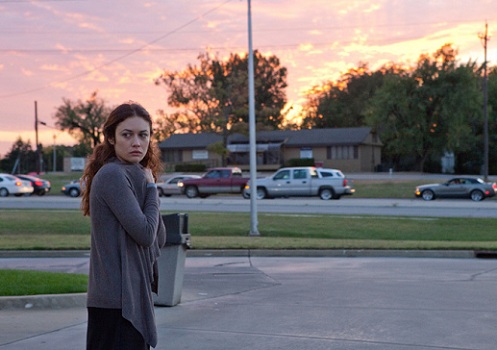
"There used always to be something to say. Now that everyone is agreed, there isn't so much to say."
Showing posts with label terrence malick. Show all posts
Monday, January 28, 2013
To the Wonder: “I write on water the things I dare not speak”
Terrence Malick’s To the Wonder premiered at Toronto and Venice last Fall to some fairly disappointed reviews, and, as much as I love the film, I guess I’m not surprised. Devoid of the monumental nature of his prior work – it’s not set against the history of Creation, or the founding of America, or World War II – it feels, at first glance, fairly slight. It’s a tale set in the contemporary world that could be outlined with a simple and predictable sentence: Boy meets girl, then meets other girl. And it pushes Malick’s style of weaving together movements and gestures and muffled words and intimate bursts of whispered narration to pretty much the breaking point. If you walked away from The Thin Red Line, The New World, or The Tree of Life wishing there had been fewer shots of people speaking in voiceover as they roamed around a beach, you’re probably screwed. But I’m here to tell you that To the Wonder is magnificent. I'm also here to tell you something about the film that might help at least some viewers understand it a bit better.
Thursday, March 22, 2012
Narration, Voiceover, and the Shape of the World
“I felt that people that frown on voiceover, it’s just a stupid thing. You think of the pictures that had voiceover, and they’re the best pictures ever. I mean, Citizen Kane, The Magnificent Ambersons, Jules and Jim. Jules and Jim is 90 percent voiceover. And The Wild Child. And even commercial films. Billy Jack had voiceover. Clockwork Orange. So that, “Show it, don’t tell it,” I think is a stupid reaction. You can be inventive in an independent picture with voiceover, and it’s one thing you can do that, in a large studio picture… they aren’t likely to do. And voiceover also helps you to cover an enormous amount of time...as long as you don’t use it the wrong way, and that is to cheat on exposition. And you can even use it that way and it’s just fine. You know, I really do believe that as long as a picture has the breath of life in it that it’s not going to matter what kind of mistakes you make, including the expository use of voiceover.” – Terrence Malick, 1976
Do we still treat narration and voiceover like proper filmmaking technique’s bastard step-child? People have been mouthing the “show, don’t tell” platitude for decades now. And it’s understandable: The desire to “tell” is often great, and it’s not a bad idea to combat convenience and temptation. But still. Forget the films Malick cites in the above 1976 quote and think of the ones we’d cite now, many moons later. Taxi Driver, Goodfellas, Malick’s own Badlands and Days of Heaven, Full Metal Jacket. Or avoid the film-snob brigade altogether and make your way down to Risky Business and/or Avatar, if you prefer.
Wednesday, October 12, 2011
Growing The Tree of Life: Editing Malick's Odyssey
Earlier this Spring I wrote an article for Cinema Editor magazine, the official publication of American Cinema Editors (ACE), in which I interviewed some of the individuals involved in the editing of The Tree of Life, which just hit DVD and Blu-Ray this week. (Some of the research for this also overlapped with my piece on Q and The Tree of Life for New York Magazine in May.) Cinema Editor has now graciously allowed me to publish the piece on this blog. (But you should consider subscribing; it's a quarterly publication, and there's lots of great stuff in there.) This version includes some material not in the original piece.
The article was written long before I actually saw the film, so it has to dance around certain elements, as did the editors themselves. (God knows, I would have had so many more questions had I been able to see and give specifics about the film before I spoke to the editors.) But it was still a fascinating experience doing it. Enjoy. And watch this space for some more Tree of Life thoughts later this week.
Saturday, July 30, 2011
Shall We Gather at the River: How "Christian" is The Tree of Life?
A couple of months ago I attended a panel discussion in New York on The Tree of Life and spirituality. It was an interesting group of speakers, even though it sounded a bit like the first line of a joke – there was a minister, a Buddhist, a humanist, an atheist, and a film producer. Fox Searchlight has graciously made some clips of various speakers available from this panel and from a similar one held in L.A. around this same time. I’ve included some clips, as well as my own thoughts, below.
Thursday, June 23, 2011
SEE THIS MOVIE: General Orders No. 9
A couple of years ago, while covering Sundance, I got an email from a friend, an industry professional and festival regular, who implored me to see an obscure film called General Orders No. 9 that was playing at Slamdance. He said it was the best movie he’d seen at Park City in all the (many) years he’d been coming there. It had one final screening on my last day in town, so after I checked out of my hotel I dutifully trudged over to Main Street. I’d gotten maybe an hour of sleep the night before (thanks to midnight screenings and writing deadlines) so I wasn’t in the best of moods when I settled in for what turned out to be a difficult, dense experimental documentary-cum-essay film. And yet this bewildering fantasia -- of almost abstracted still lives, transcendent landscapes, and incantatory narration -- enthralled me. When its director Robert Persons – a quiet, 40-something-ish fellow who’d never made a film before in his life and looked pretty uncomfortable – took the stage, my hand immediately went up for the first question: “Who the hell are you?” I asked. He wouldn’t answer me.
Wednesday, June 22, 2011
Two (More) Tree of Life Things
Believe it or not, this blog was never meant to be All Tree of Life, All the Time, but bear along with me for a little while. I'm actually working on a new, longer piece on the film, expanding and building on some of the observations in my original review. In the meantime, here are two things that may be of interest:
Monday, June 20, 2011
When Smart Writers Say Not-So-Smart Things
I know for a fact that Sam Wasson is an excellent journalist (his terrific book, Fifth Avenue, 5 A.M. made me appreciate the importance of Breakfast at Tiffany’s, a film I actually kind of hate), and he may even be a nice guy, for all I know. But he is now also the author of one of the most misguided pieces I’ve read in quite some time: this article in LA Weekly about Terrence Malick entitled “The Too Quiet American.”
Wednesday, May 25, 2011
Impending...
As The Tree of Life’s release approaches, two pretty mundane thoughts keep nagging at me. Well, not “nagging,” exactly. More like random observations that I feel I must share:
Wednesday, May 18, 2011
At the Violet Hour: A First Stab at The Tree of Life
“Sometimes I feel very old. Like my whole life’s over. Like I’m not around no more.” – Days of Heaven
The other morning my wife, my two-year-old son, and I were goofing around in our dining room, when I saw my son reach for an electrical outlet. Being the nervous, constantly worried parent that I am, I immediately yelled, “No!” at him rather firmly. This had the intended effect of preventing my son from electrocuting himself, and also the unintended one of startling and upsetting the boy. Lower lip quivering, he desperately embraced his mother as she tried to comfort him and gently told him that Daddy didn’t mean it. I, as usual, moped away, wondering if I’d done something wrong. Of course I hadn’t, but a parent constantly reflects on this kind of bizarre, ever-shifting calculus. It’s not just one thing, it’s one thing that leads to many. The things that must be done and the things that must not. The things one wants and needs and the things one has. The things one gives and the things one takes, and the things that just are. And the things that wait, unknown and unseen until they too become a part of your life. All of it, ever-expanding -- spiraling out until the whole world seems to consist entirely of these things. The kid’s only two, and I can already see it unfolding before my eyes.
I toyed with ending this review right there, just adding, “And this concludes my review of The Tree of Life, which is the greatest film I’ve ever seen. The End.” Which would have maybe been hilarious, but also misleading -- because The Tree of Life isn’t really about these above things. But these above things are part of the reason why it hit me so hard. Let’s face it, there are times in life – be they seismic struggles with grief and love that take your breath away, or mundane matters of parenting that merely prompt subdued reflection -- when you begin to feel yourself a part of something greater and ever-turning. To borrow a quote from Disney’s Peter Pan: “All this has happened before. And it will all happen again.” And then, from Eyes Wide Shut: “Until it doesn’t.”
Monday, May 16, 2011
Anticipation of the Light
So, I’ve got a piece in this week’s New York Magazine about Terrence Malick and The Tree of Life’s thirty-plus year journey to the screen. The article in its final iteration turned out a bit different than what I set out to write, for a variety of reasons, but it was still interesting talking to some of the folks from the old Q crew. I have yet to see the film, but it just premiered at Cannes, it screens for some U.S. critics today, and everybody and his mother is either talking about it or getting ready to talk about it. Many of us are still pinching ourselves, unable to believe that its release is almost upon us.
Initially, one of the things I wanted to discuss in my NY Mag piece was how Malick’s style changed over the years. Those of us who adore his work have obviously talked endlessly about the similarities between Badlands, Days of Heaven, The Thin Red Line, and The New World. But we often don’t do enough to acknowledge the very tangible and specific differences between the films, particularly those before The Hiatus and those after – as if to acknowledge such differences would be to concede ground to those who don’t find the later films to be all that. Obviously, we can all agree that the later films are more ambitious and expansive, but it seems to me the differences go deeper.
Friday, April 29, 2011
Why I Love "Indulgent" Films
I’m not one of those writers who likes to fuss over his phrasing, and I’m definitely not one of those writers who likes to come up with what he’s going to say ahead of time (in fact, I’m more the opposite – the kind of writer who comes up with something interesting to say long after he’s already filed his review), but years ago I came up with an expression I really hoped I could one day use in a review. It was inspired by some of the initial reviews coming out of Cannes about Wong Kar-Wai’s 2046. They all seemed to suggest that the film was: 1.) gorgeous and 2.) impenetrably indulgent. I hadn’t seen it, obviously, but for some reason these words flashed across my brain:
Subscribe to:
Posts (Atom)


