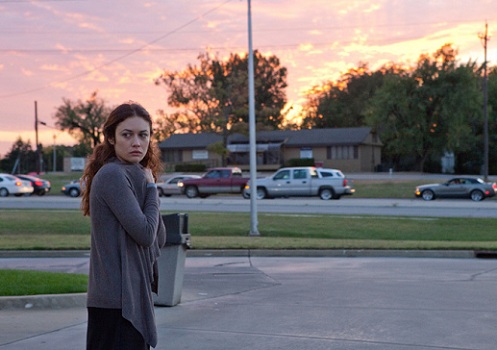
"There used always to be something to say. Now that everyone is agreed, there isn't so much to say."
Monday, January 28, 2013
To the Wonder: “I write on water the things I dare not speak”
Terrence Malick’s To the Wonder premiered at Toronto and Venice last Fall to some fairly disappointed reviews, and, as much as I love the film, I guess I’m not surprised. Devoid of the monumental nature of his prior work – it’s not set against the history of Creation, or the founding of America, or World War II – it feels, at first glance, fairly slight. It’s a tale set in the contemporary world that could be outlined with a simple and predictable sentence: Boy meets girl, then meets other girl. And it pushes Malick’s style of weaving together movements and gestures and muffled words and intimate bursts of whispered narration to pretty much the breaking point. If you walked away from The Thin Red Line, The New World, or The Tree of Life wishing there had been fewer shots of people speaking in voiceover as they roamed around a beach, you’re probably screwed. But I’m here to tell you that To the Wonder is magnificent. I'm also here to tell you something about the film that might help at least some viewers understand it a bit better.
Saturday, January 26, 2013
Pasolini and The Trilogy of Life; Or, Why It’s Important to See Films Properly
A few weeks ago I had the pleasure of introducing Pier Paolo Pasolini’s The Decameron at MoMA, and to participate the following day on a panel about Pasolini in general and The Trilogy of Life in particular, alongside Richard Pena and Simon Abrams. It was quite wonderful seeing the films again on a big screen, but I’d already had my eyes popped by seeing them a little while earlier, on Criterion’s beautiful new edition of the three films. Really, the films, both on Blu-ray and on the screen, looked brand new in ways I never thought they would. It also revealed certain things to me about them, and about Pasolini the filmmaker, that I’d never quite considered before.
Tuesday, January 1, 2013
My Top 10 Films of 2012. And Then 10 More.
With links to reviews where applicable.
1. Once Upon a Time in Anatolia (Nuri Bilge Ceylan)
“More than anything, a film about death -- or perhaps more specifically, mortality…In Ceylan’s hands, this landscape becomes a metaphysical one. The endless dark valleys of the Anatolian night, where giant stone faces lurk watching and where the characters’ own memories seem to live on forever, never quite register as a real place…Then the mythical gives way to the mundane; the mystery of death is gone, replaced instead with its physical and social consequences. And a film that began in the enveloping, sensuous darkness of a dream ends in the cold, hard light of the painfully real...”
2. It's Such a Beautiful Day (Don Hertzfeldt)
More on this later, I hope, but imagine what The Tree of Life might have been like had it been animated with stick drawings and ran a little over an hour long, without skimping on any of the ambition. This is basically that movie.
Monday, December 31, 2012
Django Unchained: The Good, the Bad, and the Incomplete
He’s one of our greatest filmmakers, but I’m not entirely convinced that Quentin Tarantino knows how to tell a feature-length story. In some ways, that’s his great advantage – an almost pathological inability to lay out his plots in the standard way.
I should qualify this sentiment, though. Jackie Brown is the closest he’s come, thanks to the fact that he was adapting an Elmore Leonard novel. But Tarantino’s other films are deliciously fragmented: Pulp Fiction and Inglourious Basterds are in effect built around several interlocking short stories; Kill Bill is a season-long TV series in miniature. Death Proof is a kind of mini-franchise of a movie and its sequel; neither is properly structured, but together they’re glorious. (And they were released as part of the grander structural experiment of Grindhouse.) Reservoir Dogs (still my least favorite of his films) feels basically like a one-act play.
Sunday, December 23, 2012
Friday, November 30, 2012
Okay, Serious Question....
It was always a bit of a running joke that in the "canonical" Jean-Claude Van Damme films of yore, his Belgian accent had to be painfully explained in some elaborate way. In Lionheart, he was a deserter from the French Foreign Legion. In Maximum Risk, he was a French cop. In Hard Target, he played a Cajun (admittedly, the film did take place in the Bayou). In Double Impact, one of his characters had been raised in a Belgian orphanage in Hong Kong. And so on. I daresay it was one of the incidental pleasures of these films.
Friday, November 23, 2012
Ghosts in the American Machine: Amistad and Lincoln
“Sir, this war must be waged on the battlefield of righteousness.”
“The what?”
- Amistad
I’ve always had a soft spot for Steven Spielberg’s Amistad. I think this puts me in some kind of minority, as that film is often Exhibit A in the Case Against Spielbergian Sanctimony. It certainly has its flaws – John Williams’s score, while lovely, swells a bit too much; Morgan Freeman gets a couple of dreadfully on-the-nose scenes; and “Give…us…free” is probably some sort of low-point for the director. But dear god, there’s so much to love here, too, quite aside from the fact that it’s a gripping, well-told historical-legal epic. Consider: The haunting scenes depicting the terror and bewilderment of the mutinous slaves as their ship comes closer ashore, or the extended flashback to the “Middle Passage” that occurs right at the mid-point of the film and spreads out in all directions like a gaping wound. And it has some of the finest performances Spielberg has ever directed, including Djimon Hounsou’s as the slave leader Cinque. The actor makes clear that the character’s fury is rooted not just in plain old anger or fear but in frustration: Cinque knows what’s going on but, a stranger in a strange land, lacks the language to express himself.
Amistad has been much on my mind lately, because it makes an appropriate companion piece with Lincoln. Not only are both films about slavery, but they’re about the specifically legal and political machinations by which the institution was maintained and then finally dismantled. Together, the two make a uniquely American diptych: They’re about a festering moral crime which needed the wedding of idealism and practicality, along with the efforts of good men, to be righted.
Subscribe to:
Posts (Atom)


